Introduction: Beyond the Pocket-Sized Screen
For decades, the primary interface between humanity and the digital world has been the handheld mobile phone, a powerful, yet ultimately two-dimensional window constrained by the physical limits of its glass screen and the necessity of focusing one’s attention downward. While smartphones achieved incredible feats in communication, productivity, and entertainment, they introduced a fundamental behavioral friction: the need to constantly look away from the real world to interact with the virtual, creating a jarring, discontinuous experience that limits true immersion and situational awareness.
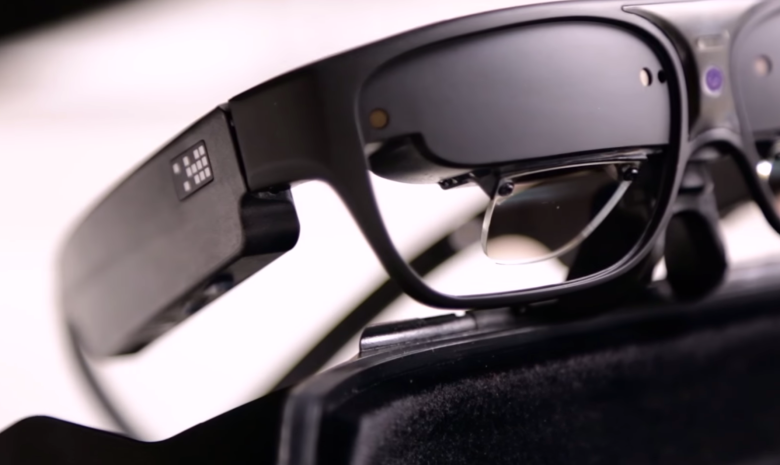
This perpetual tension between the physical environment and the digital display represents the major conceptual hurdle that next-generation computing seeks to overcome, demanding an interface that is both ubiquitous and seamless, integrating information directly into the user’s perception of reality rather than sequestering it behind a pane of glass. The emergence of Augmented Reality (AR) Glasses proposes the definitive solution to this challenge, moving digital information from being in the user’s hand to being in their field of view, overlaid directly onto the world itself.
This transformative technology is not merely about wearing a screen; it’s about shifting the computing paradigm from a constrained, portable device to a spatial operating system that blends digital data, persistent objects, and interactive tools directly into the three-dimensional space we inhabit, promising to redefine everything from navigation and communication to industrial work and education.
Pillar 1: The Core Technology: Seeing Through the Digital Overlay
The magic of AR glasses lies in the complex optical systems that manage to project digital images directly onto the user’s retina while allowing the real world to remain fully visible.
A. The Challenge of Transparent Displays
Creating a display that is both bright enough for the user to see and transparent enough to see through requires highly specialized techniques.
- Optical See-Through (OST): Most true AR glasses use an Optical See-Through (OST) design. This involves using transparent or semi-transparent components to blend the real light coming from the environment with the virtual light projected from micro-displays.
- Waveguide Technology: A leading method for achieving this is the waveguide. A microscopic grating structure etched onto a transparent lens surface guides the light from a tiny projector placed at the edge of the frame. The light then “leaks” out through the lens and into the user’s eye.
- Beam Splitters: Another technique uses beam splitters, where a transparent mirror reflects the digital image from a display module while simultaneously transmitting the real-world light through the lens, successfully fusing the two images.
B. Micro-Display Architectures
The source of the digital image must be incredibly small, lightweight, and bright enough to compete with natural daylight.
- LCoS and DLP: Early and mid-range devices often utilize Liquid Crystal on Silicon (LCoS) or Digital Light Processing (DLP) micro-displays. These technologies are miniaturized versions of projector components, offering reasonable resolution and brightness.
- Micro-OLED: The current trend is toward Micro-OLED displays. These are tiny (often less than an inch diagonally) but offer exceptional brightness, high contrast ratios (true blacks), and lower power consumption than traditional LCDs, making them ideal for the demanding AR environment.
- Laser Beam Scanning (LBS): Some systems use Laser Beam Scanning (LBS), which involves aiming miniature lasers onto a reflective surface that is then projected into the eye. LBS is known for its high efficiency and wide field of view, though color complexity can be a challenge.
C. Field of View (FoV)
The limited Field of View (FoV) remains one of the most persistent technical challenges in delivering a truly immersive AR experience.
- Human FoV: The natural human field of view is approximately 200 degrees horizontally, which makes the relatively small digital viewing area in AR glasses immediately noticeable.
- The Box Effect: Most current AR glasses offer a narrow FoV (often 30 to 50 degrees diagonally). This creates a sensation of looking at a virtual screen floating in the center of a real-world window, sometimes referred to as the “box effect.”
- Future Targets: Engineers are working to widen the FoV through more complex, multi-element waveguide designs and advanced optics, aiming for a practical, comfortable FoV of 70 degrees or more to facilitate true peripheral digital interaction.
Pillar 2: The Core Processing: Spatial Awareness
AR is fundamentally about understanding the three-dimensional space around the user, which requires a new class of sensing and processing hardware.
A. Sensing the Environment (SLAM)
The ability of AR glasses to anchor digital objects realistically to the physical world relies on sophisticated simultaneous localization and mapping.
- Simultaneous Localization and Mapping (SLAM): SLAM is the computational process that allows the glasses to simultaneously map an unknown environment and track the device’s exact position within that map. This is essential for digital stability.
- Depth Sensing: Modern AR systems use depth-sensing cameras (often LiDAR or structured light sensors) to accurately measure the distance to objects in the room. This allows virtual objects to be correctly occluded (hidden) by real-world objects.
- Feature Points: SLAM algorithms rely on constantly identifying and tracking visual feature points (corners, edges, unique patterns) in the real world to maintain a stable, non-drifting digital overlay, even as the user moves their head.
B. The AR System-on-a-Chip (AR-SoC)
AR requires a dedicated, highly efficient processor designed for simultaneous sensor fusion and complex graphics rendering.
- Sensor Fusion: The AR-SoC must rapidly integrate vast amounts of data coming from multiple inputs—cameras, depth sensors, gyroscopes, and accelerometers—a process known as sensor fusion.
- Real-Time Rendering: The processor must be powerful enough to render complex, high-resolution 3D graphics and integrate them with the real-world view in real-time, all while maintaining an extremely low latency to avoid motion sickness.
- Power Efficiency: Since the entire computing system must be housed in a small, battery-powered glasses frame, the AR-SoC must be extraordinarily power efficient to manage heat and provide useful battery life, often relying on specialized neural processing units (NPUs).
C. Persistence and Shared Experiences
The digital world created by AR must not vanish when the user leaves the room; it must be persistent and shared among multiple users.
- Cloud Anchors: To create persistent AR experiences, the map data is often uploaded to the cloud, allowing digital objects (like a virtual sticky note on a coffee machine) to remain anchored to that exact location when the user or another user returns later.
- Multi-User Mapping: Shared AR experiences—where two or more users can view and interact with the same virtual object in the same physical space—require the glasses to rapidly align their separate maps of the world into a single, synchronized coordinate system.
- Spatial Computing OS: The underlying operating system must transition from a folder-based structure to a spatial computing environment, treating physical locations, walls, and objects as the primary organizational structure for digital files and applications.
Pillar 3: Interacting with the Immersive Interface
As the display moves off the phone and onto the face, new methods of input and interaction are required, moving beyond touchscreens.
A. Gaze and Voice Control
These two input methods are the most natural and least intrusive ways to interact with the hands-free AR environment.
- Gaze Interaction: The simplest form of interaction is gaze tracking, where the user selects items or initiates actions simply by looking at them. This requires highly accurate internal cameras that track the precise movement of the user’s pupils.
- Voice Commands: Voice commands provide a natural, hands-free way to invoke applications, search for information, or control the system (e.g., “Hey AR, start navigation to the nearest cafe”). This requires advanced, localized noise cancellation and speech recognition.
- Haptic Feedback: Since there is no physical screen to touch, feedback must be provided through subtle audio cues or haptic feedback mechanisms embedded in the glasses’ temples, signaling a successful selection or a new notification.
B. Gesture Recognition
Using hand and finger movements in free space allows for more complex, intuitive interactions with virtual objects.
- Camera-Based Tracking: AR glasses use outward-facing cameras to track the user’s hands and finger positions in three dimensions, allowing the user to “pinch” to select, “swipe” through menus, or “grab” and move virtual objects.
- Hand Skeletalization: The system runs complex machine learning models to perform hand skeletalization, mapping the 3D position of every joint in the hand. This allows the system to recognize complex, customizable gestures.
- Ease of Use: Effective gesture control must be low-effort and reliable. Gestures that require excessive repetition or that feel unnatural quickly lead to frustration and abandonment of the interface.
C. Auxiliary Input Devices
While hands-free interaction is the goal, some complex tasks still require the precision of external, specialized controllers.
- Wrist-Worn Controllers: Small, wrist-worn controllers or specialized rings can provide high-precision input, acting as a virtual mouse or providing precise haptic feedback for delicate virtual tasks.
- Brain-Computer Interfaces (BCI): The long-term frontier involves integrating Brain-Computer Interfaces (BCI), where simple neural signals could be used to select options or manage focus, potentially achieving the ultimate form of hands-free interaction.
- External Pairing: AR glasses will always need seamless pairing with other devices—especially the user’s smartphone or smart ring—to offload complex computation or to use the phone’s full-sized keyboard and display when contextually appropriate.
Pillar 4: Transformative Applications and Use Cases
AR glasses move beyond mere entertainment, promising revolutionary changes across professional, educational, and everyday consumer domains.
A. Enhanced Navigation and Communication
Integrating digital guides directly into the user’s line of sight will fundamentally change how we navigate and interact socially.
- In-Sight Navigation: AR can project turn-by-turn directional arrows and point-of-interest markers directly onto the road or building, eliminating the need to look down at a map and greatly improving situational awareness while walking or cycling.
- Real-Time Translation: For international travelers, AR glasses can perform real-time text translation, overlaying the user’s language onto foreign signs, menus, or subtitles in real-time, blurring language barriers.
- Digital Avatars: In communication, AR can overlay digital data onto people, such as name tags, social media handles, or simple context notes, enhancing memory and social interaction.
B. Industrial and Professional Productivity
The hands-free nature of AR glasses provides immediate, tangible benefits in complex technical environments where accuracy is critical.
- Assisted Maintenance: Field technicians can view step-by-step assembly or repair instructions overlaid directly onto the equipment they are working on, including interactive 3D models and diagnostics, drastically reducing error rates.
- Remote Expert Assistance: AR allows a remote expert to draw or highlight specific parts of a machine in the field worker’s view, guiding them through a repair procedure in real-time, bridging geographical distances for technical support.
- Architectural Visualization: Architects and engineers can use AR glasses to overlay a full-scale 3D model of a new building onto an empty construction site, allowing for real-time design reviews and conflict detection before construction begins.
C. Education and Training
AR facilitates deeply immersive and interactive learning environments that significantly improve retention and practical skill development.
- Interactive 3D Models: Students can view and manipulate holographic 3D models—such as the human heart, complex chemical structures, or historical artifacts—right on their desk, leading to a much richer understanding than traditional two-dimensional textbooks allow.
- Virtual Labs: AR can create safe, virtual laboratory environments for complex or dangerous experiments, allowing students to practice procedures and make mistakes without physical risk or the consumption of expensive materials.
- On-the-Job Training: AR glasses can guide new employees through complex tasks with context-aware prompts and checklists appearing only when they look at the relevant piece of machinery or equipment, accelerating the learning curve.
Pillar 5: Hurdles, Ethics, and the Path to Mass Adoption
The transition from smartphone to AR glasses requires overcoming not just technical obstacles but also significant societal and psychological hurdles.
A. Technical and Usability Challenges
Despite impressive advancements, several fundamental usability issues currently prevent AR glasses from replacing the smartphone for all tasks.
- Motion Sickness (Simulated Vestibular Conflict): If the display lag or tracking latency is too high, the visual information the user sees conflicts with the body’s vestibular system, leading to nausea or motion sickness. Low latency is non-negotiable.
- Social Acceptance and Aesthetics: Current AR glasses often look bulky, conspicuous, or distinctly “techy,” hindering social acceptance. Mass adoption requires the devices to resemble normal, stylish eyewear as closely as possible.
- Battery Life and Thermal Management: High-power AR-SoCs and bright micro-displays generate significant heat. Balancing the need for multi-hour battery life with the requirement to keep the device cool and lightweight on the user’s face remains a core engineering hurdle.
B. Ethical and Privacy Concerns
Wearing a device that constantly records, processes, and maps the world raises profound questions about privacy and data collection.
- Constant Recording: The presence of always-on cameras and microphones capable of recording and live-streaming from the user’s perspective creates massive privacy concerns for bystanders who are unaware they are being recorded or tracked.
- Data Security and Biometrics: AR glasses collect highly intimate biometric data (gaze patterns, head movements, environment maps). Securing this deeply personal, persistent environmental data from hacking or unauthorized use is a critical mandate.
- The Filtered Reality: Questions arise regarding the ethical use of “filters” or persistent digital overlays. Concerns exist about potential misuse for disinformation, targeted psychological manipulation, or creating a deeply personalized, but false, reality bubble.
C. The Ecosystem and Cost Barrier
Establishing a robust and desirable AR ecosystem requires overcoming the initial high cost of entry for both consumers and developers.
- Ecosystem Maturity: A successful AR platform needs millions of users, but users won’t buy the hardware without compelling software. Building a mature ecosystem of killer applications is a chicken-and-egg problem requiring massive initial investment.
- Developer Tools: Providing simple, effective developer tools and standardized APIs is vital to lower the barrier for independent developers to create innovative spatial computing applications, moving beyond basic porting of existing mobile apps.
- Price Parity: To truly replace the smartphone, AR glasses must eventually achieve a price point competitive with high-end mobile phones. Reducing the cost of complex optical and sensing components is the key to unlocking this mass-market price.
Conclusion: The Ultimate Interface Shift

Augmented Reality glasses represent the foundational technology poised to succeed the smartphone as the defining personal computing interface.
This technological leap relies on sophisticated Optical See-Through (OST) systems, primarily utilizing complex waveguides and bright, minuscule Micro-OLED displays to overlay digital images onto the real world.
The hardware demands the integration of advanced sensors and SLAM (Simultaneous Localization and Mapping)algorithms to maintain spatial awareness and anchor digital objects realistically.
Achieving practical performance requires a powerful, low-latency AR System-on-a-Chip (AR-SoC) that fuses massive sensor data streams for real-time graphics rendering.
Interaction must move beyond touch, relying heavily on natural gaze tracking, voice commands, and precise hand gesture recognition for a seamless, hands-free user experience.
The applications are transformative, ranging from in-sight navigation and real-time language translation to hands-free, guided instruction for complex industrial maintenance tasks.
Widespread adoption is currently limited by significant hurdles, including social acceptance, the narrow Field of View (FoV), and the ongoing challenge of achieving sufficient battery life in a lightweight form factor.
Critical ethical concerns, particularly regarding bystander privacy and the constant collection of biometric and environmental data, must be proactively addressed through strong regulatory frameworks.
AR glasses promise to deliver the long-awaited shift to spatial computing, where the physical world itself becomes the interface, making information truly ubiquitous and contextual.